


🎧 Prefer Audio?
Here’s a human-recorded audio version with Chief Voice Officer Kirk McDavitt. Hit play, or keep reading below.
Where We Are
A second-year teacher needs to order graduated cylinders for a science unit starting in fourteen days.
She starts with her department chair, who points to a requisition form that isn’t in the shared drive. She asks the admin. assistant, who suggests checking with the purchasing manager. She asks a veteran colleague, who shrugs and says, “I usually just email the principal and hope for the best.”
After three days, five conversations, and zero clarity, she reaches a breaking point. It’s not a loud break; it’s a quiet one. She opens her laptop, goes to Amazon, and spends $73 of her own money.
That isn’t a “busy teacher” problem. It’s a systems problem.
The Invisible Tax
Last week, we looked at why parents see your school as a “black box,” defaulting to emailing whoever is most accessible because they don’t know who actually does what.
But your teachers are navigating that same fog every day.
When we talk about school systems, we often treat them as cold, administrative plumbing. But for the people living inside them, systems are cultural signals. They tell your staff exactly how much you value their time and their talent.
When a teacher can't find the "front door" to a basic process, they pay an invisible tax, one that drains the cognitive energy that should be reserved for students.
The solution isn't complex. You don't need new software or a complete culture overhaul.
You need to make the invisible visible.
Why It Matters
When systems are opaque, three things happen (and each one carries a cost your school can’t afford):
The Cognitive Load Tax
Teachers spend an average of 4.7 hours per month hunting for procedural information such as forms, approval workflows, who handles what. Cognitive Load Theory confirms what teachers already know: when working memory is cluttered with procedural confusion, there’s less room for creative problem-solving. Every minute spent thinking “How do I even do this?” is a minute not spent thinking “How can I better support my students?”
The Innovation Ceiling
The science teacher with the $73 cylinders had three other ideas that month. She didn’t pursue any of them. When the “tax” to innovate is too high, teachers stop trying. They don’t quit their jobs; they quit their ideas.
The “In-Crowd” Gatekeeping
If “how things work” only lives in the heads of the veterans, you’ve accidentally created a hierarchy. New hires and international staff are left outside the circle, forced to beg for information. That isn’t just inefficient; it’s inequitable.
When onboarding depends on tribal knowledge rather than documented processes, you’re telling new teachers: “Figure it out, or prove you’re worthy of help.” That’s not the culture most schools claim to want.
A Favorite Diagnostic: The Journey Map
If you’ve followed my work for any length of time, you know I’m a dedicated proponent of this tool—not just as an operations enthusiast, but because I believe that better systems are the highest form of empathy we can offer our staff. Journey mapping is, quite simply, my #1 recommendation for school leaders who want to move from "putting out fires" to building sustainable systems that center the human experience.
You can’t fix a system you haven’t seen, and this kind of audit allows you to do just that.
Journey Mapping is a diagnostic tool that traces the actual steps, thoughts, and frustrations a teacher experiences while trying to get something done. It’s not about how the process should work; it’s about how it feels right now.
To show you what this looks like in practice, I’ve mapped out that opening story to visualize the “Current Reality,” turning a confusing maze into a visible path:
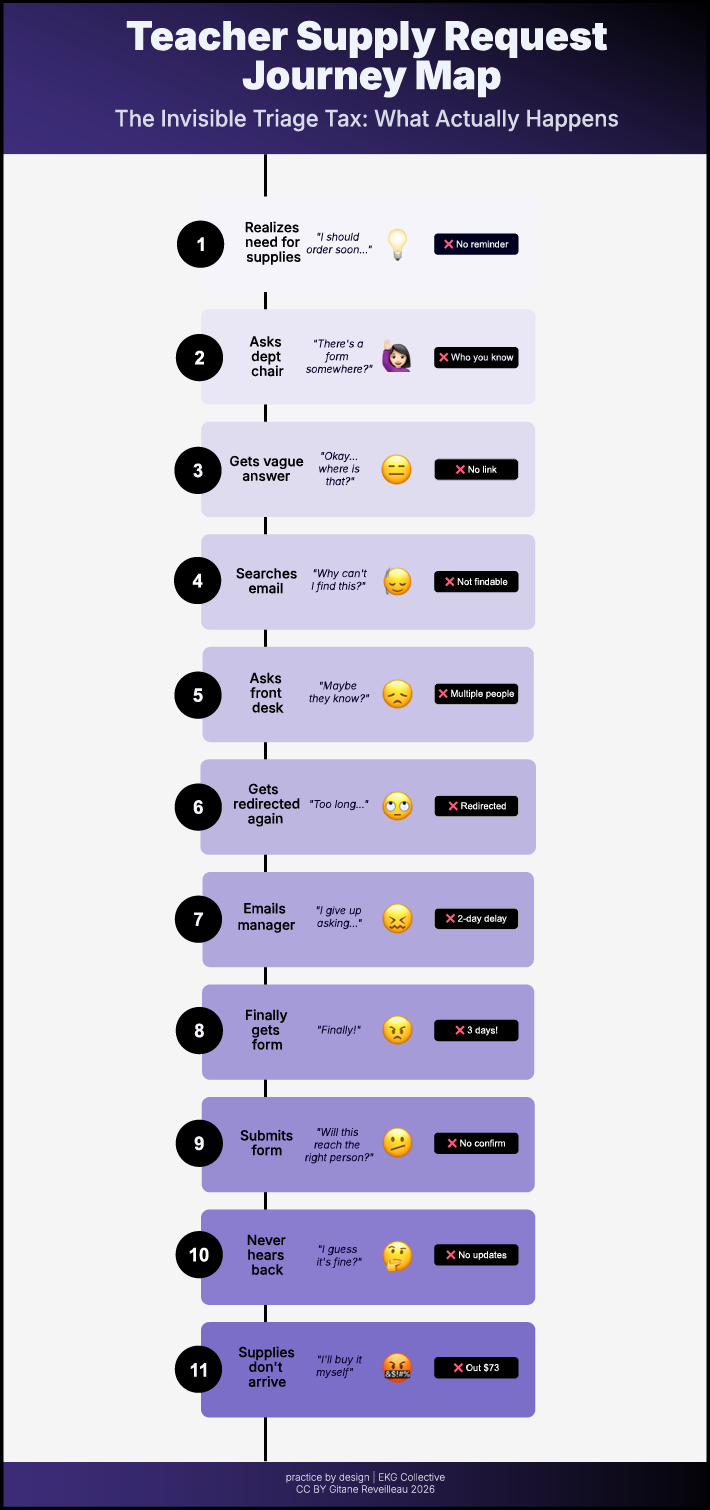
When you see the map, the fix becomes obvious. It’s rarely about the teacher’s capability: it’s about the lack of an entry point and the absence of a status bar.
Small Wins: The Power of the Front Door
Improving a system doesn’t have to mean writing a 50-page handbook or overhauling your entire culture.
Sometimes, it’s as simple as building a clear front door.
Think about the smallest friction point in your school: a broken stapler in the workroom, a lightbulb out in the hall, or a room that needs booking. If the teacher has to think for more than three seconds about who to tell, the system is broken.
A “Small Win” is putting a QR code on the wall that says “Report an Issue Here.”
It moves the cognitive load from the teacher to the system.
This Week’s Move: Trace One Path
Pick the one process that causes the most “How do I...” emails in your inbox. Maybe it’s room bookings, IT tickets, or facilities requests.
Instead of guessing where the friction lies, take 20 minutes to perform a simple audit on that one process.
Here’s the simplest way to map the current reality:
Identify the Entry Point: Where exactly does a teacher start? (An old email? A specific person? A bookmark they made during orientation week and can never find?)
Document the Micro-Steps: List every single action they take. Don’t skip the “small” things, like “waited two days for a reply” or “searched the shared drive for five minutes.”
Layer in the Emotion: At each step, note the feeling. Are they feeling supported, or are they feeling like they’re being an “annoyance” just by asking?
Find the Resignation Point: Identify the exact moment where the teacher decides it’s easier to just do it themselves or give up entirely.
Don’t try to solve the problem this week. Just document the reality as it exists today. Once you see the emotional arc of your systems, the path to rebuilding them becomes clear.
What’s Coming Next in the Beyond the Org Chart series
Next week: Pathmaps Over Policy: Making School Systems Intuitive
Once you’ve mapped where teachers get lost, I’ll show you how to rebuild the process with clear pathways, transparent timelines, and documentation that actually lives where people can find it.
By the end of next week, you’ll have documented and published pathways for the processes that currently live only in people’s heads.
Systems as Care: See you at AAIE!
Next week, I’ll be heading to the AAIE (Association for the Advancement of International Education) conference to lend a hand to the wonderful AAIE core team with comms and logistics. (Have I mentioned I’ve been an assistant producer and executive assistant in the “before international teaching” times? I still love a good high-stakes logistics puzzle 😉.)

I will also have an opportunity to speak with school leaders from around the world.
I’ll be presenting “The Handoff Problem: Designing Better Family Experiences Across Your Technology Systems.” Whether it’s a teacher trying to order supplies or a family trying to navigate enrollment, if the baton is dropped between departments, the whole system slows down. We’ll be exploring how to bridge those silos to serve our communities better.
Because, beyond efficiency, clear systems are a form of care.
If you’re attending AAIE in Toronto, come say hi 👋 on Wednesday, February 4th at 9:30 AM. Let’s talk about how to make the invisible visible.
Your Experience
I’m genuinely curious: what’s the one process in your school that makes teachers feel like they’re bothering someone just by asking?
Hit reply and tell me, or leave a comment below. I learn a great deal from your replies and comments.
Systematically yours,

About the Author:
G (short for Gitane) is co-founder and Chief Creative Officer at EKG Collective, helping international schools turn communication complexity into systematic clarity. Learn more at ekgcollective.com.
"They tell your staff exactly how much you value their time and their talent." so true.