


🎧 Prefer Audio?
Here’s a human-recorded audio version with Chief Voice Officer Kirk McDavitt. Hit play, or keep reading below.
Where We Are
A colleague stopped me during last week’s AAIE gathering in Toronto with a story about a week of silence that nearly broke her trust in her daughter’s school.
The daughter, a well-adjusted, 15-year-old student at a boarding school, had been feeling progressively excluded from her classroom/social circles. For this family, the situation felt especially vulnerable and confusing.
So the parent did what parents normally do: She emailed the advisor on Monday. The advisor replied almost instantly: “I’ll look into this and get back to you soon.”
Then... silence.
Tuesday. Wednesday. Thursday. By Friday, the parent was concerned. Did they forget? Am I being a helicopter parent? Is my daughter being overly sensitive?
What my colleague did not know then: The advisor had already put the word out to the grade-level team, observed two lunch periods, consulted the counselor, and interviewed a couple of her classmates.
They were working incredibly hard. But to the parent, that week was a “Black Box” of perceived abandonment.
This is the Silent Gap: the psychological void that opens when a parent knows they’ve asked for help, but has no idea if anyone is actually listening.
The Line of Visibility
In part 1 of this 5-part series, we talked about Service Blueprinting, which is the line between what parents see (Frontstage) and what you do (Backstage).
We solved Routing (part 1) and Entry Points (part 3). But we haven’t fully addressed the Visibility Gap.
Most schools treat a parent concern like a library book: you check it in, and you don’t hear anything until it’s due back.
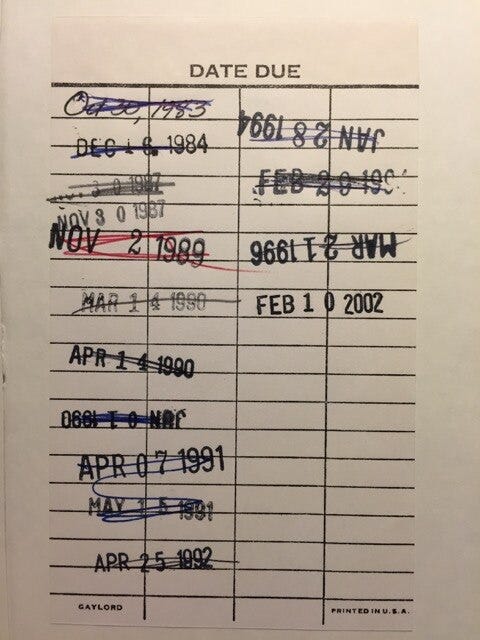

But a child is a high-stakes emotional investment, and when a parent enters the “Black Box,” they don’t just wait. They invent narratives. And often, the narrative is: “The school does not care as much as I do.”
The Solution: Making the Backstage Visible
If you want to stop the “just checking in” emails that clog senior leadership’s inboxes, you don’t need a better policy. You need to eliminate the silence.
Enter the “Pizza Tracker for Pedagogy”
Companies like Domino’s and Amazon revolutionized the experience of waiting. Domino’s famously realized that customer frustration isn’t caused by the 30-minute wait, but by the 30-minute void. When you can see the dough being prepared and the pizza entering the oven, your brain moves from “Where is my dinner?” to “My dinner is in progress.”
But a school isn’t delivering pizzas. When a parent asks about a social conflict or a learning gap, they’re asking about something at the core of your educational mission. What happens next—the observations, the consultations, the adjusted seating arrangements—isn’t administrative overhead. It’s pedagogy. And if it’s invisible, its value is invisible too.
By making your “backstage” milestones visible, you prevent worried parents from becoming angry parents.
When families feel informed, they are significantly less likely to escalate a classroom issue to the Board or the Principal’s office. You aren’t just “being nice”; you are strategically protecting your team’s time.
The Strategy
For high-anxiety processes like investigations or learning support referrals, give the family a clear picture of what's going to happen before the work begins. Then keep them updated as it unfolds.
Two tools make this work efficiently:
1. The Tracker
Imagine an internal tracker where a staff member simply checks a box for “Observation Complete.” That check triggers an automated, branded email to the parent: “Update: We have moved to Stage 3. This means our team is now reviewing observations to draft a plan. Expect a human check-in by [Date].”
It's a small ask for IT that creates a high-trust experience for the family.
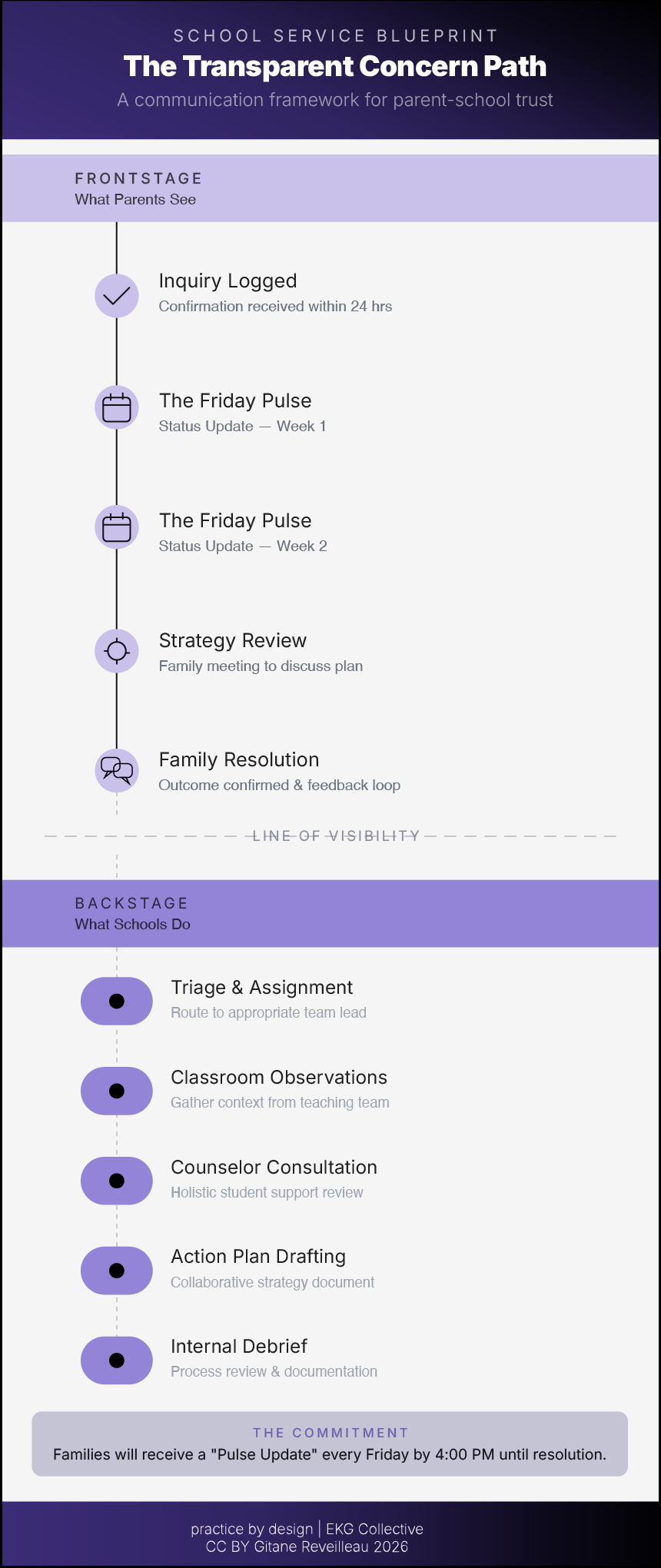
Stage 1: Logged & Assigned
Stage 2: Observing & Gathering Information (classroom observations, reviewing relevant records)
Stage 3: Team Consultation
Stage 4: Action Plan Drafted
Stage 5: Family Resolution Meeting
2. The Friday Pulse (The “Anti-Anxiety” Protocol)
This is the simplest, highest-impact system you can implement right now. If a case is open, the parent gets a “Pulse” update every Friday before 4:00 PM, even if there is no new news.
“Hi [Parent], we are still in the observation phase of the social concern you raised. We’ve completed two observations and have one more scheduled for Monday. I’ll have a full update for you by Wednesday. Have a restful weekend.”
To give you an example you can replicate at your school, I’ve designed the Transparent Concern Path, which is a blueprint that maps your internal “backstage” efforts to the “frontstage” parent experience.
The Skeptic’s Reality Check
You might ask: “Isn’t this just more work for an exhausted staff?”
The hard truth is that you are already doing this work. You are just doing it in the form of “damage control” later. When we leave parents in the dark, we aren’t saving our staff’s time, but merely deferring the expenditure of it until it’s paid back with the interest of a parent’s anxiety.
Silence creates a reactive cycle where your team spends more time answering “what’s the status?” than they would have spent simply providing it.
Writing a 30-second “Pulse” email on Friday is a choice; dealing with an angry parent on Monday morning who thinks you’ve ignored them all week is a crisis. One requires a brief moment of focus; the other requires a meeting, a debrief, and a significant emotional toll.
Systemic transparency is about front-loading communication to prevent the “Black Box” from turning into a fire.
This Week’s Move: Audit the Silence
Pick your school’s most opaque process (likely your IEP path or Discipline/Bullying investigations).
Define the Milestones: What are the 4–5 “Backstage” steps that parents currently never see?
Assign the Pulse: Who is responsible for the Friday update? (Hint: It’s often an administrative assistant or case manager, not the busy teacher).
Request the Automation: Sit down with IT and ask: “How can we trigger a milestone email based on a status change in our internal tracker?”
Want Help Fixing Your Visibility Gaps?
It’s hard to spot (and fix) problems when you’re stuck in the day-to-day grind. I help teams find those blind spots where stakeholders are spiraling in silence and build the automated solutions needed to win back their trust.
If you want to eliminate the “Silent Gap” but don’t have the internal bandwidth to lead the audit yourself, let’s talk. 👋
What’s Coming Next in the Beyond the Org Chart series
(This) Series Finale
We've fixed routing, mapped teacher journeys, built pathmaps, and closed the visibility gap with families. But every one of those problems traces back to a single root cause: people don't understand who does what, why, or how those roles connect to each other.
In the final installment, I'm introducing the Role Ecosystem: a framework that replaces your static org chart with a living map of how roles actually activate when something happens.
Because fixing processes only works if everyone can see their part in the system.
Systematically yours,

About the Author:
G (short for Gitane) is co-founder and Chief Creative Officer at EKG Collective, helping international schools turn communication complexity into systematic clarity. Learn more at ekgcollective.com.