


🎧 Prefer Audio?
Here’s a human-recorded audio version with Chief Voice Officer Kirk McDavitt. Hit play, or keep reading below.
Where We Are
A father raises a concern about bullying. He emails the advisor, just as the school directory instructed. The advisor responds promptly and says she will look into it.
A week later, the father runs into the division head at drop-off and mentions the situation. The division head has no idea what he’s talking about.
Not because the advisor dropped the ball. She is mid-investigation, gathering observations, consulting with the counselor. She hadn’t looped in the division head because there was nothing to escalate yet.
She was being efficient. But to the father, she looked like she was acting in a vacuum.
In that 30-second conversation at the curb, the father goes from trusting that the process was underway to wondering: “How seriously are they taking this?” Before leaving the parking lot, he emails the head of school.
Now the head of school contacts the division head, who contacts the advisor, who feels blindsided and undermined. A chain reaction happens because the father interpreted a routine information gap as institutional neglect.
The advisor did her job. The division head was appropriately out of the loop. And the father’s conclusion was entirely reasonable given what he could see.
That is not a people problem. That’s a systems problem.
The Pattern Behind Every Problem in This Series
That one conversation at the curb contains every problem we’ve explored in this series.
In part 1, parents emailed three people about one concern because they couldn’t tell whose job it was. In part 2, a teacher spent $73 of her own money because nobody owned the procurement path. In part 3, we built pathmaps because process documentation existed, but navigation didn’t. In part 4, a parent spiraled in silence because the advisor’s work was invisible to the person it served.
Four different symptoms. One diagnosis: role legibility, or the ability for every person in your school community to understand who does what, why, and how those roles connect in real time.
This is different from the visibility we discussed last week. Visibility is whether you can see that work is happening. Legibility is whether you can read who does what and how those roles connect.
The Expectations Gap
In most schools, if you ask staff members to write down the responsibilities of the person in the next role over, the answers will not align. (Try it at your next staff meeting. Make a game of it. The results might surprise you!)
The teacher assumes the counselor is making the call. The counselor assumes the advisor is already on it. The advisor assumes the teacher is managing the classroom fallout. The division head assumes everyone is in the loop because of an email thread from last Tuesday.
I call this the Expectations Gap: the invisible mismatch between what each person believes other roles are doing and what those roles actually do.
It turns professional collaboration into a game of administrative hot potato. 🥔
And it’s not just staff. Every person in your school carries an internal map of how the system works. Parents have one. Teachers have one. Counselors have one. These maps aren’t wrong, exactly. But nobody has ever laid them side by side to see where they diverge.
Go back to the father at pickup. His map said: “I contacted the advisor. If something important were happening, leadership would know.” The advisor’s map said: “I’m coordinating a team response. The division head gets involved only if this escalates to a formal investigation.”
Both maps were reasonable. Neither was shared. And what collapses in that gap is trust.
The Expectations Gap explains why well-meaning people in well-designed schools still produce misaligned outcomes. Everyone is operating from their own map, and nobody has checked whether the maps match.
💡 Go Deeper: Mental Models
Design researcher Indi Young calls these internal maps “mental models,” detailed representations of what a person thinks, feels, and does while trying to achieve a goal. Young’s work suggests that we cannot design a solution until we understand the internal reasoning of the people involved.
If you’ve been following the thinking styles approach from earlier in practice by design, this is the same principle applied to organizational coordination.
From Org Chart to Role Ecosystem
An org chart is a photograph. It captures reporting lines at a single moment in time, frozen and flat.
What you need is a film. You need to see how roles move, connect, and respond when something actually happens.
I’m calling this the Role Ecosystem: a scenario-based map of how roles activate, interact, and hand off when triggered by a specific event.
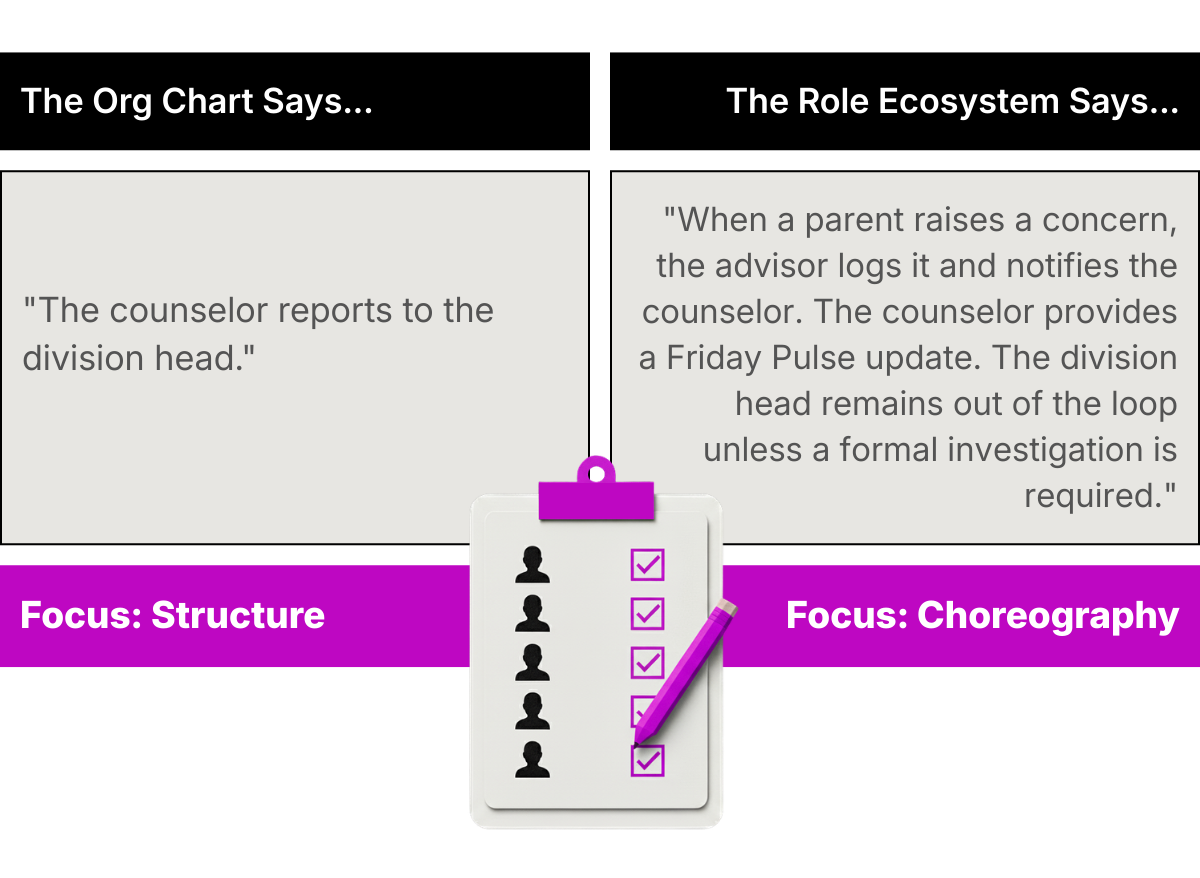
If the father from our opening story had received a message at the start saying, “Your advisor is leading this process. The division head becomes involved only if the concern moves to a formal investigation,” that pickup conversation would have gone very differently. He wouldn’t have interpreted the division head’s unawareness as negligence. He would have understood it as the system working exactly as designed.
💡 Go Deeper: Teaming
Amy Edmondson, a Harvard Business School professor who studies how organizations coordinate under uncertainty, draws a distinction that matters for schools. She separates teams (static groups with stable membership who practice together) from teaming (the ability to coordinate fluidly with people you may not have worked with before).
Schools are teaming environments. Your counselor, advisor, and classroom teacher don’t sit in a room together every day as a fixed team. They form temporary constellations around specific students, then dissolve when the situation resolves. Edmondson’s research shows that when you can’t rely on shared history to drive coordination, you need explicit role structures that tell people their cue, their handoff, and what others can see.
That is exactly what the Role Ecosystem provides. If teaming is the mindset, the Role Ecosystem is the scaffolding.
🎥 Highly recommended watch: How to turn a group of strangers into a team ⬇️

Building Your Role Ecosystem: The Three-Layer Approach
You don’t need to map every scenario in your school. Start with one high-friction situation and apply three layers.
Layer 1: The Trigger Map
Pick a scenario. Let’s use the one from this series: “Parent raises a concern about their child’s social experience.”
List every role that gets activated: Advisor. Counselor. Grade-level team. Classroom teacher. Division head. Front office (who might receive the initial call). Even the parent themselves. They have a role in this system too.
Layer 2: The Choreography
For each role, define three things:
What do they do first? The advisor logs the concern and acknowledges receipt within 4 hours.
Who do they notify, and when? The advisor alerts the counselor same-day. The counselor briefs the teacher before any classroom observation.
What does the family see? The advisor sends a confirmation email. The counselor sends the Friday Pulse. The division head is invisible unless escalation occurs.
This is where you’ll discover the gaps.
Layer 3: The Visibility Assignment
This is what makes a Role Ecosystem different from a workflow chart. For every action in the choreography, ask: Who can see this happening?
Some actions should be visible to the family (the acknowledgment email, the Friday Pulse). Some should be visible only to staff (the internal consultation, the observation notes). Some need to be visible to leadership (escalation triggers, resolution timelines).
When you map visibility alongside choreography, you eliminate two problems at once: the internal confusion about who does what and the external silence that makes families lose trust.
The Skeptic’s Reality Check
“We already have protocols for this.”
Maybe. But can your new advisor, the one who started in August, describe the coordination sequence without asking a veteran colleague? Can a parent tell you what happens after they send the email?
If the protocol lives in a Google Drive folder nobody remembers about, it’s not a protocol. It’s a wish.
The difference between a protocol and a Role Ecosystem is the difference between a recipe locked in a drawer and a recipe taped to the kitchen wall. The content might be identical, but it’s the accessibility that makes it top of mind.
Schools that document role coordination for common scenarios (parent concern, student support referral, new family onboarding) spend significantly less time doing damage control.
It’s all about eliminating the guesswork that creates duplicated effort.
The Series in One Frame
Before we wrap, here’s the full "Beyond the Org Chart” system, viewed from five angles:
◈ The Directory tells people where to go.
◈ The Journey Map shows where the friction is.
◈ The Pathmap tells them how the process works.
◈ The Pulse proves that the process is working.
◈ The Role Ecosystem tells your team who does what, when, and in coordination with whom.
Each post in this series gave you one piece. Together, they form a complete communication architecture for your school.
This Week’s Move: Build One Choreography
Here’s the fastest way to find the biggest gap in your school’s coordination: look for the handoff where two people both assume the other is acting.
Step 1: Identify the scenario that generates the most “who’s handling this?” friction. (If you’re not sure, look at where leaders get cc’d most often. That’s usually the gap.)
Step 2: List every role that activates when this scenario occurs.
Step 3: For each role, write one sentence answering: “What do they do first, and who do they notify?”
Step 4: Draw the visibility line. For each action, note whether the family can see it happening or not.
You’ll likely find at least one handoff where nobody owns the update and at least one moment where the family goes dark.
Those are your design opportunities. That's your practice by design.
Just the commitment to notice where systems fail people and to do something about it, one choreography at a time.
A Short Intermission
This post concludes the Beyond the Org Chart series, and the timing feels right for a brief pause. I want to wish a restful February break to the many schools on holiday this week, and a happy Year of the Horse 🐴 to those celebrating the Lunar New Year.
I’m taking a short break to focus on The Clarity Sprint I promised earlier this year. To be transparent, the volume of work has been more significant than I anticipated, which is a positive problem to have!
I’ll be back in your inbox in early March with fresh insights and the final release of this one-hour, self-paced course.
Systematically yours,

About the Author:
G (short for Gitane) is co-founder and Chief Creative Officer at EKG Collective, helping international schools turn communication complexity into systematic clarity. Learn more at ekgcollective.com.
as always, amazing work!