


Here’s a human-recorded audio version with Chief Voice Officer Kirk McDavitt. Hit play, or keep reading below.
Where We Are
It’s a scene we all know: July/August orientation. The campus is buzzing. There are branded tote bags, administrators waiting at the airport, and curated cocktail hours where everyone’s name tag includes their home country and a fun fact.
We treat the beginning like a welcome home: meticulously planned, and centered on belonging.
Now look at the end of that journey.
When the same staff member leaves three, five, or ten years later, the experience often feels like a quiet eviction. The “Departure Protocol” is usually a dry HR checklist: return your keys, sign this form, empty your cubby, and clean up your drive.
In international schools, where 15 to 25 percent of our community turns over every single year, this isn’t a “niceness” problem. It’s a design failure.
Welcome to the first installment of Leaving Well, a series on redesigning the final 10% of the school experience to protect institutional knowledge and honor the people who built it.
The Experience Asymmetry
In UX design, professionals talk about the “onboarding” and “offboarding” of users. Schools have borrowed the language, but perhaps not the intention.
Great companies know that the way a user leaves a service determines whether they’ll ever come back, or what they’ll tell their friends.
In my experience, schools have a massive experience asymmetry.
We invest heavily in the “Hello” and almost nothing in the “Goodbye.”
Think about it. Your onboarding probably has 15 to 20 intentionally designed touchpoints. The orientation spreadsheet alone runs multiple tabs. There’s a welcome committee. A mentorship program. A “First 30 Days” plan.
The offboarding, on the other hand? Maybe 3 to 5 touchpoints, and most of them, administrative.
That gap is not neutral. It has costs, and they’re bigger than most school leaders realize.
Three Hidden Costs of a Bad Goodbye
1. The Friction Cost
Here’s an experience I’ve personally witnessed: A curriculum coordinator left an international school after eight years. She’d built a Google Site that served as the central hub for her program: resources for parents, unit overviews, event calendars, contact information. The Admissions team linked it in its official resources for new families. Families bookmarked it. Teachers used it, too, but perhaps not as often. It was, for all practical purposes, the public face of that department.
When she departed, nobody flagged the site as institutional property. For different logistical reasons, it lived under her personal school account. And when the agreed-upon date for account deletion arrived, IT followed the protocol. The account was deleted, and so was that site. Gone.
What came next was a slew of 404 errors and emails to the front office asking what happened. The front office didn’t know. Neither did the new curriculum coordinator, who now took it upon himself to rebuild the whole thing with bits and bobs shared by older staff. And that was his first quarter of school experience…
That’s the Friction Cost. Every hour a new hire spends reconstructing what already existed is an hour they’re not spending on students. An employee who departs without structured knowledge transfer can create 40 to 80 hours of ramp-up work for their replacement.
2. The Cultural Cost
Doug Ota, author of Safe Passage and one of the leading voices on transitions in international schools, names three groups in every school community: Arrivers, Leavers, and Stayers.
Most schools focus their energy on Arrivers (welcome!) and Leavers (goodbye!). But the Stayers carry the heaviest load. They’re absorbing the emotional weight of colleagues departing. They’re rebuilding team dynamics every August. And they are watching.
If you treat departing staff like they’ve already vanished, you teach your remaining staff that loyalty has an expiration date. Stayers don’t say it out loud, but they think it: Is this how they’ll handle it when I leave?
That thought doesn’t show up in exit interviews. It shows up in engagement surveys, in the slow burn from people who watched a decade of service get acknowledged with a card and a hallway handshake.
3. The Brand Cost
International education is a small world, and your departing staff are about to enter the rest of it.
In the tight-knit circuit of international schooling, your reputation isn’t just built by your brochure. It’s built by the teacher at a dinner party in Bangkok talking about how they felt during their last month at your school in Bogotá. It’s the counselor at a regional conference answering the question everyone asks about their former school: “How was it there?”
The answer to that question is shaped far more by how they left than by how they arrived.
A teacher who felt valued on the way out becomes an ambassador. A teacher who felt like a line item on a checklist? That story travels too.
And It's Not Just Staff
Students and families experience this asymmetry too, often more sharply.
When a student who’s been at your school for six years transfers out, what happens to their digital life? In most schools, IT deactivates the account. Google Drive files, Seesaw portfolios, messages from teachers, blogs and digital artifacts of their entire school identity, gone. Often without warning.
When we delete digital identities without support or ceremony, we’re telling departing families: your data mattered to us while you were enrolled. Now it doesn’t.
That’s not malicious. Nobody intends that message.
But intent and experience are two different things, and in design, experience is the one that counts.
Talking about experience…
Ready to simplify how your school communicates?
Every email, update, and announcement is a designed experience, whether you intended it that way or not. The Clarity Sprint is a self-facilitated 60-minute team workshop that helps you find the friction and fix it: language, format, handoffs, and context.
Three tracks: Admin, Comms, or Teachers.
One goal: reaching the reader where they are.
The Design Shift: From Compliance to Contribution
To fix this, we need to move away from a Compliance Mindset (”Did they follow the departure rules?”) to a Contribution Mindset (”How are they leaving a legacy?”).
The first step is seeing the friction.
In design, we use a Friction Audit to identify where a process is slowing people down or causing frustration. If a teacher spends their last two weeks in a state of panic trying to “clean up” their files while also saying goodbye to students, writing report cards, and packing up an apartment to ship overseas, that is high-friction design. It’s bad for the teacher, and it’s bad for the school.
The Tool: The Departure Experience Audit
This week, I want to challenge you to look at your school’s exit process through the lens of a journey map. Instead of evaluating the checklist, map the actual experience a departing person encounters.
The Four Phases of Leaving Well:
1. The Announcement. How is the news shared? Does the person feel like a “traitor” or a celebrated alumnus? Is the timing controlled and dignified, or does word leak out through the rumor mill before the person has even told their closest colleagues?
2. The Harvest. Is the handover a chore (filling out forms in the final week) or a consultation (structured knowledge-sharing sessions across the final month)? Is the departing person treated as someone being mined, or as someone contributing their wisdom?
3. The Sunset. When does digital access end? Is it a cliff (locked out at midnight on the last day) or a ramp (a guided two-week transition window where files are migrated, access is transferred, and nothing important falls through the cracks)?
4. The Ritual. Is the farewell generic (”Thanks for your years of service!”) or specific (”Here’s the impact you had on our science department, and here’s how we’re making sure it lives on”)?
What’s Coming Next in the Leaving Well series
Next week: The Knowledge Harvest. How to move beyond the “handover folder” and capture the informal wisdom that actually keeps a school running. The official documentation most schools request captures about 20% of what matters. I’ll show you how to get the other 80%.
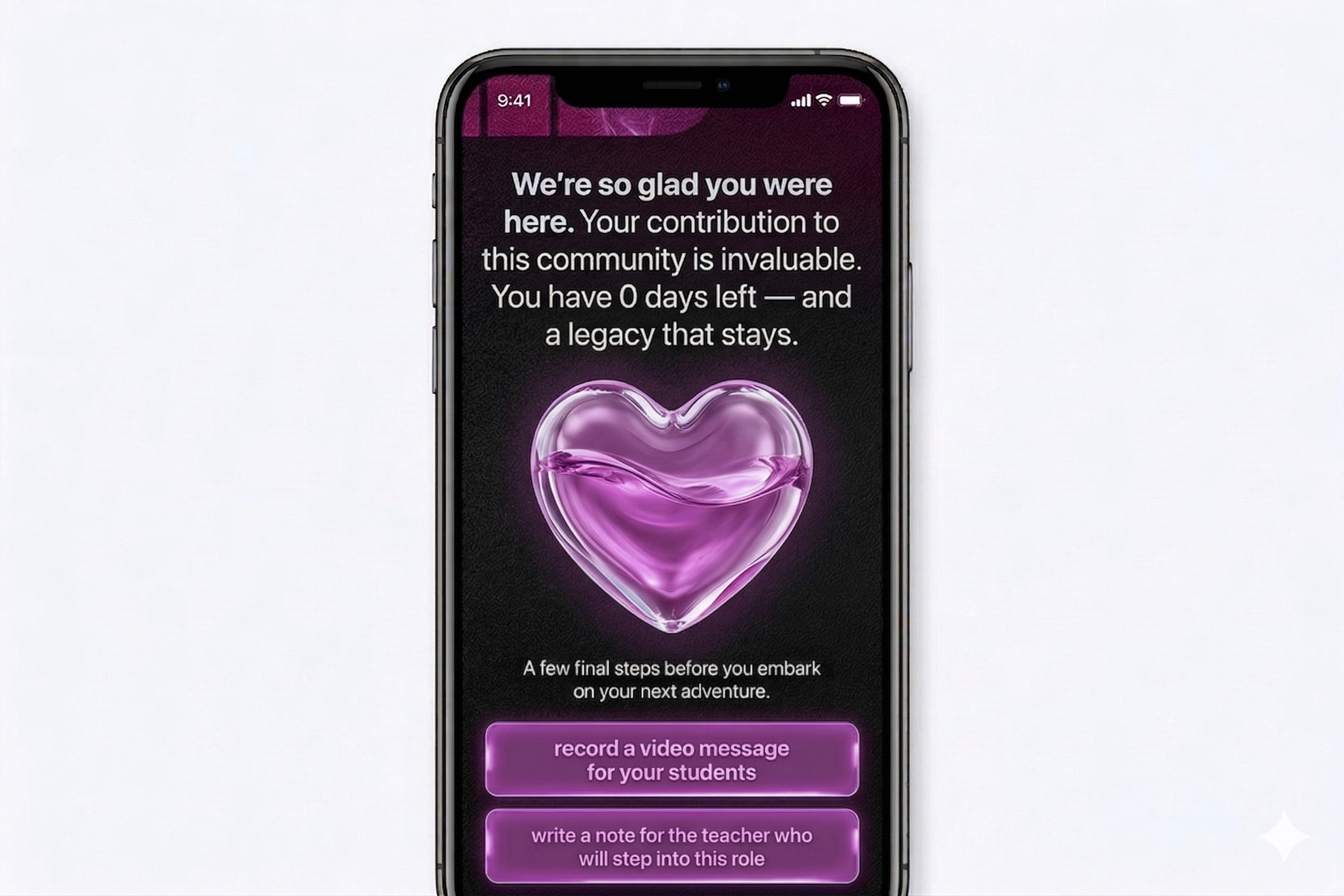
This Week’s Move
Pick one role, a staff member who left recently, or a student family who transferred out. Map the four phases, as described above:
1️⃣ Announcement
2️⃣ Harvest
3️⃣ Sunset
4️⃣ Ritual
Then do this ⤵️
The practice by design Prompt
Take your current exit checklist and put it on your desk. Cross out every item that exists for the school’s legal or administrative protection: keys, laptops, forms, signatures.
What’s left?
If the answer is an empty page, that's not the end of the process. That's the beginning of a better one. Next week, we go beyond the checklist.
Your Experience
What’s the best goodbye you’ve ever witnessed at a school? And what’s one departure experience that still makes you cringe? Hit reply. I’m building this series from your stories, and every response shapes what comes next.
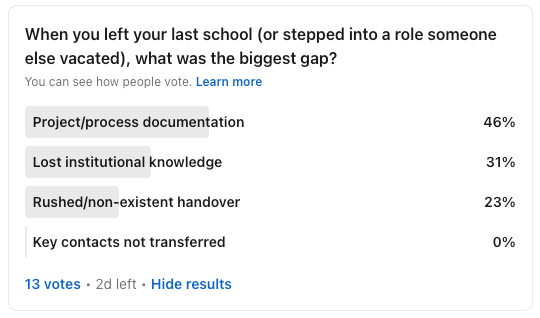
By the way, I’m still collecting answers for this poll I started last week. Here’s what my LinkedIn network thinks:
Systematically yours,

About the Author:
G (short for Gitane) is co-founder and Chief Creative Officer at EKG Collective, helping international schools turn communication complexity into systematic clarity. Learn more at ekgcollective.com.
Oh man, your story about the curriculum coordinator leaving is so real. I’ve lived that more than once in my career. Love your focus on systems and institutional clarity.