


Here’s a human-recorded audio version with Chief Voice Officer Kirk McDavitt. Hit play, or keep reading below.
Where We Are
Maddie was eighteen when she finally named the ghost in the room. In an interview with researcher Tanya Crossman, she said:
I lived with a mentality that “everyone leaves.” I just recently moved off to college and I had a really close friend get mad at me for pushing her away... Honestly, I still expect us to eventually lose touch anyway because people move on. That’s all I’ve ever known.
Crossman heard some variation of “everyone leaves” in scores of the 270 interviews for her book Misunderstood: The Impact of Growing Up Overseas in the 21st Century (2016).
Think about that as a design constraint. This goes beyond “sadness.” It is a worldview. It is a logic model for human connection baked in before adulthood: Attachment is just the first half of loss.
When we don’t design the departure experience, we aren’t just losing institutional knowledge. We are unintentionally mass-producing a generation of “Internal Leavers,” people who start exiting a relationship the moment they start it.
This isn’t a criticism of schools; it is a call for more deliberate design.

The Leavers: Grief Wearing a Hoodie
When a family leaves, they lose the “background noise” of their lives: the specific slant of 4 PM light in their kitchen, the shortcut through the park, and the barista who knows their order.
Adults often prioritize the logistics: the shipping container, the last phone bill, the “exciting move.” Children, however, live in ambiguous grief. Nothing is “wrong,” really. The family chose this, often after thoughtful discussions about the future. Yet a ten-year-old is still left with the feeling that their world has ended.
Usually, they put that feeling in a box labeled “Resilience.”
In the international school world, “They’re so resilient” is often a polite way of saying “I’m glad they aren’t making a scene.” But as Reddit’s TCK communities often point out, that “resilience” is often just emotional calcification.
Researchers call it “Expat Child Syndrome.” It looks like withdrawal or teenage moodiness. but in reality, it’s just grief wearing a hoodie.
The Stayers: The Perpetual Tour Guide
Here is the part that our schools unintentionally leave out: It is often harder to be the one left behind.
While we throw farewell parties for the families moving to London or Singapore, the children staying behind are treated as a non-issue. The common assumption is that they’ll simply make new friends and move on.
But in a school with 20% turnover, a “stayer” doesn’t just lose one friend. They lose their social infrastructure. Every June is a demolition; every August is a construction site.
On TCK forums, stayers often describe feeling like “perpetual tour guides.” They get tired of explaining the “inside jokes” to new arrivals. They get tired of being the only one who remembers the bench by the science building was “ours.”
This builds the “Everyone Leaves” armor. These kids learn to connect superficially because “going all-in” on a friendship feels like volunteering for heartbreak.
The Opportunity for Intentional Design
This emotional landscape isn’t anyone’s “fault,” but it is a gap that schools are uniquely positioned to fill.
When a family departs or a friend stays behind, parents often feel a lingering sense of isolation. They watch their children navigate these transitions and hope the institution that brought them together can help navigate the fallout.
Schools don’t need to take the blame for the nature of global mobility, but they can take the lead in being more deliberate. By treating transitions as a design challenge rather than a logistical one, we move from “handling” departures to honoring them.
Designing the Goodbye
If we treated departures with the same intentionality we bring to curriculum design, our approach would shift:
Naming the Loss: While well-intentioned, “happy talks” about exciting new chapters can feel like emotional gaslighting to a child who is hurting. Intentional design means using language that acknowledges that goodbyes are hard and significant.
Closure Rituals for Kids: Adults design goodbye events for adult comfort—speeches, gifts, and photos. Children need agency; in this case, the ability to influence how their own story ends at a school. Moves are almost always “done to” children, leaving them feeling like passive cargo. Shifting this power allows them to choose the scale and style of their goodbye, moving them from being spectators of a transition to the architects of it. This might look like “friendship time capsules” or collaborative projects that remain at the school after the student leaves, ensuring their presence is still felt.
The August/September “Stayer” Check-in: We can design specific touchpoints for the students who stay. A check-in during the first few weeks of school should focus on the “Swiss cheese” holes in their social circle, acknowledging that the start of school is a social transition even if they didn’t move.
The “Stay-in-Touch” Bridge: Left to chance, these friendships often evaporate. Schools can facilitate the handoff by normalizing the exchange of contact info and supporting alumni networks that have a more intentional focus on connection. And when that bridge-building is done well, it starts to look less like a school initiative and more like a philosophy. One organization has already mapped what that philosophy looks like.
The Alumni Manifesto
[YELLOW CAR]’s Alumni Manifesto offers a framework that treats alumni engagement as a direct continuation of the student experience.
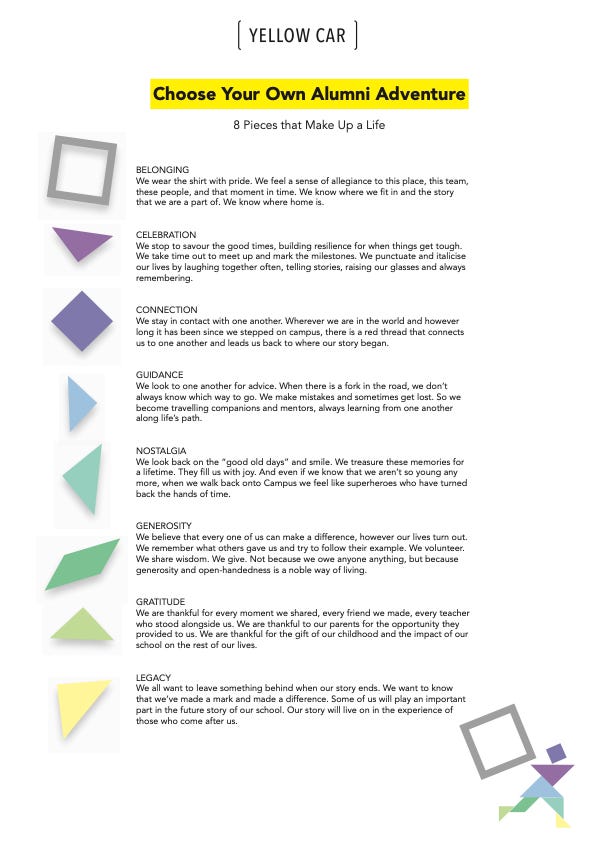
Imagine handing a graduating student a “backpack” containing eight elements they can “play” in different combinations throughout their lives.
When we design for the long term, we offer our students:
Belonging & Connection: A sense of home and a “red thread” that keeps them connected to their story.
Guidance & Mentorship: Lifelong traveling companions who offer advice when they hit a fork in the road.
Nostalgia & Celebration: Punctuation marks for their lives, remembering the milestones and the “good old days.”
Generosity & Legacy: An open-handed way of living where they leave a mark for those who come after.
This framework transforms the school from a place they used to attend into a lifelong “home base.”
This Week’s Move
This is a great opportunity for some internal research. Start by identifying a “Long-Term Stayer”—a student who has watched multiple cohorts of friends depart. As keepers of your school’s memory, they offer unique insight into the emotional weight of social turnover. Then:
The One-Question Interview: Ask: “When your friends leave, what do you wish the school did?”
Active Listening: Avoid the urge to “fix” or explain. Document the raw feedback.
Agenda Item: Place this feedback at the top of the next Senior Leadership Team meeting to serve as the catalyst for a “Transitions-Care” protocol.
The children who stay can tell us exactly what is broken. We just need to be deliberate enough to ask.
Systematically yours,

About the Author:
G (short for Gitane) is co-founder and Chief Creative Officer at EKG Collective, helping international schools turn communication complexity into systematic clarity. Learn more at ekgcollective.com.