


Here’s a human-recorded audio version with Chief Voice Officer Kirk McDavitt. Hit play, or keep reading below.
Where We Are
You arrive at your new school in August. You’re jet-lagged, overstimulated, and trying to remember which building has the staff room and which one has the copier that actually works.
You’ve stepped in to coordinate a department at a moment of significant change. Someone points you toward the “Handover Folder” your predecessor left behind. You open it.
One Word document. Three broken links. A couple of login credentials.
It’s a very true story 🙋🏻♀️.
This, in UX design, is what we call a “dead end” — a repository where information goes to die because it was never designed for the person actually using it. The folder wasn’t built for you. It was built to satisfy the requirement that something was left behind.
In last week’s post, we explored the Experience Asymmetry — how schools invest enormous energy into arrivals and treat departures as administrative afterthoughts. Today, we’re looking at the remedy: The Knowledge Harvest.

The cost of getting this wrong is not abstract. ISC Research’s Global Market Overview 2025 confirms what most international school leaders already feel in their bones: in a sector now employing over 730,500 staff across 15,000 schools, teacher movement is only accelerating. With nearly half of surveyed teachers planning to move on within one to six years, that's not a trickle of turnover. That's a river.
Here is the number that should be front-and-center in our transition planning: research consistently shows that approximately 42% of institutional knowledge lives exclusively inside individual employees’ heads. When those people leave, that knowledge doesn’t get filed. It vanishes.
The same research, from Panopto, found that knowledge workers waste an average of 5.3 hours per week either waiting for information from colleagues or recreating knowledge that already existed somewhere. Schools aren't knowledge-economy companies, but the pattern is identical: your new Digital Learning coordinator spending weeks rediscovering what your departing coordinator already knew — that’s not an onboarding hiccup. That’s a design failure.
The "Jobs to Be Done" Lens
There’s a powerful framework from design thinking called Jobs to Be Done, popularized by Clayton Christensen at Harvard Business School. The core insight is elegantly simple: people don’t buy products. They hire them to accomplish a specific job.
Apply that lens to the transition:
When a departing staff member creates a handover, they aren’t just “documenting their work.” They are building a tool that their successor is hiring to survive their first 90 days.
Instead of asking, “What did I do?” (which produces a data dump), the departing person should ask, “What does my successor need to accomplish?” (which produces a map). The difference is as stark as handing someone a phone book versus handing them directions to the restaurant.
The Three-Layer Handover Protocol
In my experience, handovers usually only capture the procedural “what.” But institutional knowledge has three distinct layers. The deeper you go, the more fragile—and valuable—the knowledge becomes.
Layer 1: The Process Layer (The “What”)
This is the standard content: curriculum maps, schedules, login credentials, and budget spreadsheets.
Process knowledge is the skeleton of the role. To make it more effective:
Make it visual: A flowchart of the field trip approval process is ten times more useful than a five-page memo. Decision trees and workflow diagrams speak a universal language.
Record it, don’t just write it: A 3-minute screen recording of how to navigate the budget request system is worth more than a page of text. Your successor can pause, rewind, and follow along.
Tool Tip
With Google Workspace for Education, which many of our schools use, this is built directly into your workflow. You can use the native Record feature in Google Slides to capture your screen and voiceover simultaneously, or use Google Vids to create a quick, polished instructional clip.
📽️ Here’s a Google Vids tutorial to get you started, by fellow creator Dean Stokes.
Layer 2: The Relationship Layer (The “Who”)
Schools run on social capital. Every veteran staff member carries an invisible map of relationships: who to call when the copier breaks on the morning of the school play; which parent needs a five-minute check-in before a committee meeting; which department head is irritable on Friday afternoons.
This layer is almost never documented, yet it takes new hires the longest to rebuild.
Create a Stakeholder Map: Who are the five people your successor needs to have coffee with in their first week? Who is the unsung hero in the admin office?
Record a “Relationship Briefing”: This works beautifully as a 5-minute voice memo. It’s conversational and captures nuances that written notes flatten. Your successor can listen to it on their commute during their first week.
Doug Ota’s research in Safe Passage reminds us that transitions are relational disruptions. A stakeholder map doesn’t replace those lost connections, but it prevents a “cold start.”
Layer 3: The Contextual Layer (The “Why”)
This is the most fragile knowledge—and the most expensive to lose. It’s the “why” behind the “what.” Why did we stop using that math resource? Why do we hold the assembly in the gym instead of the theater?
Tacit knowledge—the unwritten, experience-born understanding that shapes daily decisions—represents roughly 80% of an organization’s total knowledge base. This is where institutions develop amnesia.
Build Video Time Capsules: A 2-minute video of a departing coordinator answering one specific question is worth more than a hundred pages of documentation. Keep the prompts specific. To ease the process, I’ve built a set of cards you can use:
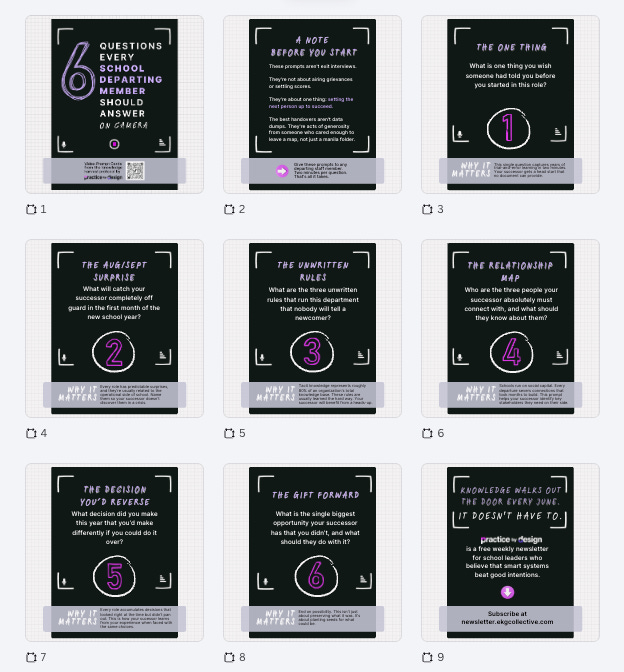
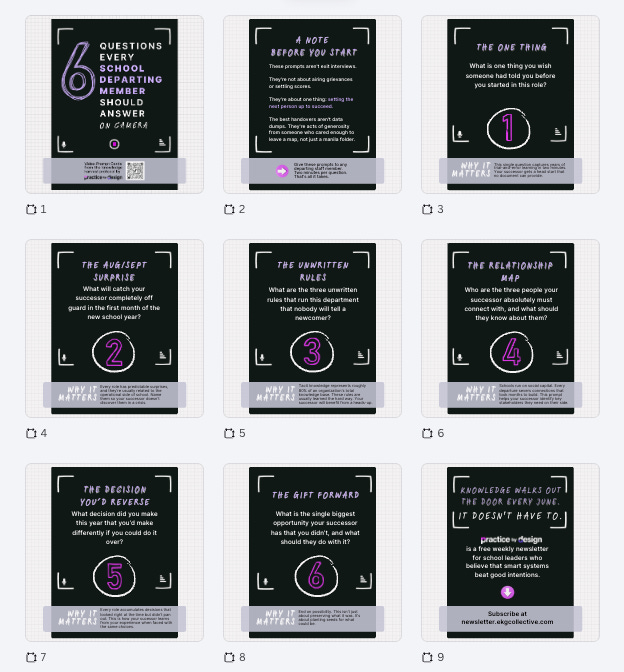
🔗 Download and save the full-sized cards here.
When to Start the Harvest (Hint: Not the Last Week!)
The Knowledge Harvest should begin the moment someone announces they’re leaving—not during their final week when they are mentally packing boxes.
The Ideal Timeline:
Post-Announcement: Schedule the Process Layer capture. It’s straightforward and low emotional load.
Start of Second Semester: Facilitate the Relationship Layer. This often sparks meaningful reflections on the connections they’ve built.
Final 2 Weeks: Record the Contextual Layer. The “why” stories flow more naturally when someone is already in a reflective, looking-back mindset.
Ownership matters: A “Transition Lead” or supervisor should facilitate this. Left to their own devices, most people default to a data dump. They need someone to ask the right questions.
Not sure who should lead this? Sometimes an outside perspective can ask the questions that feel too “obvious” for colleagues to raise. This is what we do at EKG Collective. If you’d like help designing your transition process, let’s talk!
Reframe the Handover as a Legacy
We often treat handovers as a chore—the last administrative box to tick before heading to the airport. But when we design them through the lens of legacy, the energy shifts.
The departing person isn’t being “strip-mined” for info; they are planting seeds. They are ensuring the programs they spent years building don’t develop amnesia the moment they walk out the door.
What’s Coming Next in the Leaving Well series
Next week: The Family Experience. How to design for the families staying behind and those leaving alongside you.
This Week’s Move
Think about the most critical function in your school that currently lives exclusively inside someone’s head. Ask that person one question:
“If you had to leave tomorrow, what are the three ‘pro-tips’ your successor would need to survive their first month?”
Record the answer. A voice memo, a quick video, or a sticky note. You’ve just started your harvest.
Systematically yours,

About the Author:
G (short for Gitane) is co-founder and Chief Creative Officer at EKG Collective, helping international schools turn communication complexity into systematic clarity. Learn more at ekgcollective.com.
Great advice!!